 EN


Concept Development and Prototype Validation
Aligning Aesthetic Vision, Brand Identity, and Functional Requirements for the perfume bottle
Aligning aesthetic vision with functional requirements early prevents costly redesigns. The perfume bottle must express brand identity through silhouette, finish, and decorative surfaces while meeting neck finish specifications, pump or crimp compatibility, overflow capacity, and filling-line stability. A 2023 product development benchmark found that concept decisions lock in about 70% of total manufacturing cost. Cross-functional teams should define weight, glass clarity, label area, and base geometry before tooling begins. Marketing teams often favor tall, slender forms for shelf appeal, while packaging engineers require sufficient wall thickness and a stable base—shapes with sharply tapered shoulders may look elegant but risk thin glass zones and filling turbulence. Design-for-manufacturing reviews should include blow-mold simulation before form approval. Resolving these tensions at the concept stage reduces scrap, accelerates approvals, and safeguards scent presentation. Documenting the target closure, collar, and dip tube length also prevents late-stage fit issues that can delay launch. This stage should yield a control drawing and a preliminary risk assessment covering filling, capping, and leak testing.
Rapid prototyping, mold tooling trade-offs, and structural integrity testing for luxury perfume bottle forms
Rapid prototyping in resin or CNC-machined acrylic enables fast evaluation of luxury perfume bottle forms—confirming visual proportion, label fit, and hand feel within days. Though these models cannot replicate glass mold flow behavior, they support early ergonomic and aesthetic validation. Mold tooling trade-offs become critical: production tooling demands high upfront investment and longer lead times. Some manufacturers use pilot molds or bridge tooling to validate glass distribution before committing to multi-cavity investment. Structural integrity testing on actual glass samples then measures vertical load, impact resistance, thermal shock response, and neck concentricity. Skipping these tests raises the risk of late-stage cracking and sealing failure, as noted in a 2023 packaging engineering review. Clear pass/fail limits for wall thickness and finish diameter must be established before scale-up. Pilot sampling also reveals whether the chosen glass composition meets optical clarity and recycled-content targets under real-world conditions. This balanced sequence preserves prototype speed while validating material performance under actual filling and shipping stresses.
Material Engineering and Sustainability Considerations
Glass selection: flint vs. crystal, PCR content, lightweighting, and refill compatibility for premium perfume bottle designs
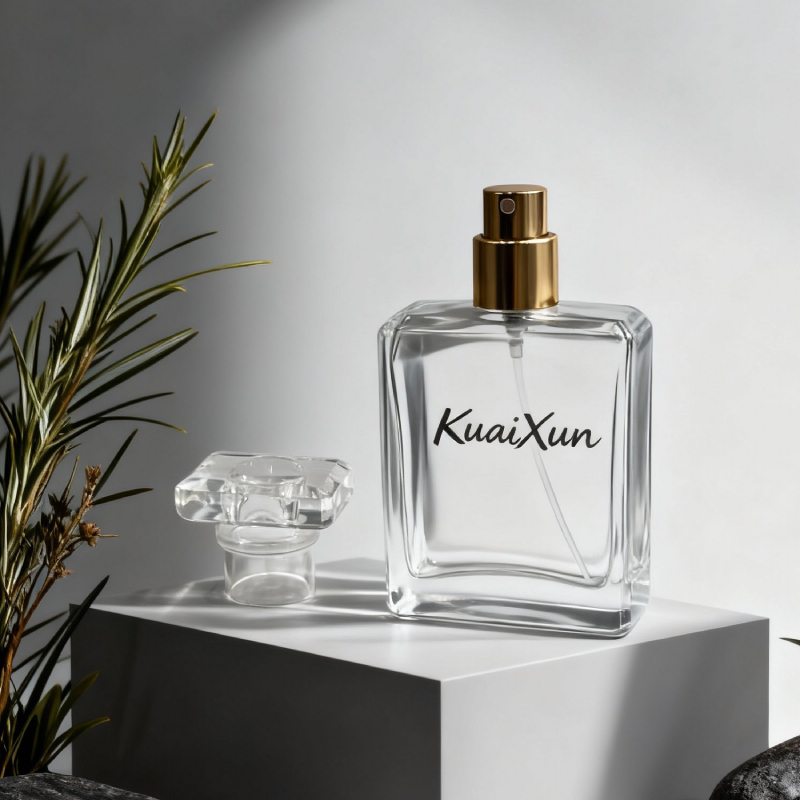
Material choices directly shape both perceived value and environmental footprint. Flint glass offers high clarity and cost stability for standardized luxury lines; crystal glass—with added minerals such as barium or titanium—delivers greater refractive brilliance and heft, though it requires higher forming temperatures and tighter annealing controls. Premium brands increasingly specify post-consumer recycled (PCR) content—typically 20–40% in outer glass—to reduce raw material demand without compromising clarity when sourced from high-purity cullet. Lightweighting strategies can cut bottle mass by 15–30% through optimized wall distribution and base design, lowering transport emissions while preserving impact resistance and neck strength. Refill compatibility extends product life: standardized neck finishes like 15 mm crimp or screw-thread formats allow consumers to reuse the same flacon with replacement cartridges, reducing single-use packaging. Together, these decisions help balance luminous aesthetics, mechanical durability, and circular design goals across premium perfume bottle ranges.
Precision Forming Techniques for High-End Perfume Bottles
Blow-and-blow, press-and-blow, and NNPB processes — how each shapes clarity, wall uniformity, and neck precision in the perfume bottle
In high-end perfume bottle manufacturing, the forming method directly influences optical clarity, wall uniformity, and neck precision. Blow-and-blow uses compressed air to form both the parison and final shape—ideal for narrow-neck designs but prone to slight wall variation near the shoulder. Press-and-blow employs a plunger to shape the parison before final blowing, improving wall distribution in wider or heavier bases and minimizing surface contact marks. NNPB (Narrow Neck Press and Blow) presses the entire parison—including the neck—before final blowing, often reducing glass usage by 20–30% while tightening dimensional accuracy. Neck inner diameter tolerances are routinely held within ±0.2 mm to ensure consistent cap and crimp fit. All three methods preserve clarity when paired with polished molds and plungers and controlled cooling profiles to prevent distortion. Bottle makers select blow-and-blow for traditional silhouettes, press-and-blow for thicker bases, and NNPB where exact wall uniformity and neck precision are paramount. These choices also affect annealing profiles, as uneven wall thickness increases residual stress and crack risk. Each process is validated in prototype trials before scale-up.
Scalable Production Strategies: Automation, Craft, and Quality Trade-offs
Scaling a perfume bottle production program requires aligning throughput targets with the finishing quality that defines a luxury product. Automated blow-and-blow or NNPB lines achieve 40–80 bottles per minute and deliver repeatable neck finishes, wall distribution, and base thickness—but higher speeds compress time for fire-polishing, annealing, and surface inspection. Standard clear bottles may tolerate this trade-off; sculpted or coated variants typically cannot.
The trade-off becomes clearer when comparing three common strategies:
| Strategy | Typical use case | Quality impact |
|---|---|---|
| Fully automated line | High-volume standard perfume bottle shapes | Strong dimensional consistency and lower per-unit cost, but limited ability to handle irregular exteriors or hand-applied decoration. |
| Craft-assisted line | Limited-edition, heavy-wall, or sculpted perfume bottles | Higher visual richness and perceived value, but longer cycle times and greater dependence on skilled labor. |
| Hybrid cell | Premium runs with consistent neck finish and selective hand-finishing | Balances output with artisanal detail, at the cost of more complex scheduling and quality gates. |
Manufacturers often scale production by adding hybrid cells rather than eliminating craft steps entirely. Automated take-out, vision inspection, and leak testing reduce handling marks and improve defect detection—while hand-polishing, acid-etching, or metalizing remain in slower manual stations. This preserves brand differentiation without making every unit cost-prohibitive.
Process control further shapes quality. Adaptive systems monitor mold temperature, gob weight, and cooling curves in real time. According to Deloitte (2024), 62% of manufacturers plan to use AI in production by 2025, enabling lines to adjust settings before defects accumulate. Yet those tools require calibrated sensors and operator training. Without clear standard operating procedures, automation only speeds up the production of flawed perfume bottles—not their improvement.
Final Quality Assurance and Packaging Readiness Testing
Leak resistance, dimensional tolerance, surface finish, and cap-seal validation specific to perfume bottle performance
Before a perfume bottle is cleared for filling and dispatch, final quality assurance focuses on four failure-prone areas. Leak resistance is verified via vacuum or pressure decay tests—a leaking bottle compromises fragrance integrity and shelf life. Dimensional tolerance checks confirm the neck bore, finish, and body diameter fall within specification so pumps, caps, and crimp seals seat correctly. Surface finish inspection under controlled lighting detects scuffs, bubbles, or uneven coatings that would undermine perceived luxury. Cap-seal validation confirms closure torque and seal compression maintain a consistent barrier against volatile fragrance evaporation. Random sampling typically follows an AQL plan such as ANSI/ASQ Z1.4 to detect defects after at least 80% of goods are packed. Together, these checks reduce batch-level escape risk and ensure every perfume bottle meets brand, regulatory, and packaging readiness standards before leaving the line.
FAQ Section
Why is rapid prototyping important in perfume bottle design?
Rapid prototyping accelerates early evaluation of aesthetic and ergonomic aspects, enabling fast adjustments before committing to production tooling.
What are the main advantages of using NNPB over other forming methods?
NNPB reduces glass usage by 20–30% while ensuring tight dimensional accuracy, especially for neck precision and wall uniformity.
What sustainability initiatives are prominent in perfume bottle development?
Sustainability efforts include using post-consumer recycled (PCR) content, implementing lightweighting strategies to reduce transport emissions, and ensuring refill compatibility to minimize single-use packaging.
How do manufacturers balance automation and craftsmanship in luxury bottle production?
Hybrid cells combine automated processes for consistency and efficiency with hand-finishing elements for artisanal detail, achieving a balance between scalability and premium quality.
What quality checks are included in final assurance for perfume bottles?
Final checks involve leak resistance tests, dimensional tolerance confirmation, surface finish inspections, and cap-seal validation to ensure functionality and a luxury appearance.
Table of Contents
- Concept Development and Prototype Validation
- Material Engineering and Sustainability Considerations
- Precision Forming Techniques for High-End Perfume Bottles
- Scalable Production Strategies: Automation, Craft, and Quality Trade-offs
- Final Quality Assurance and Packaging Readiness Testing
-
FAQ Section
- Why is rapid prototyping important in perfume bottle design?
- What are the main advantages of using NNPB over other forming methods?
- What sustainability initiatives are prominent in perfume bottle development?
- How do manufacturers balance automation and craftsmanship in luxury bottle production?
- What quality checks are included in final assurance for perfume bottles?