 EN


Why Perfume Bottles Leak in Transit: Root Causes and Transport Stressors
Leakage during shipping is rarely random—it results from predictable physical forces acting on the closure system.
Pressure Differentials in Air Cargo and Altitude Changes
Air cargo holds are typically pressurized to a cabin altitude of 2,400 m (8,000 ft), where external pressure drops to about 75 kPa compared with 101.3 kPa at sea level (ICAO 2023). A sealed perfume bottle filled and capped at ground level retains near-101.3 kPa internal headspace pressure—creating a 26 kPa outward differential that stresses the cap liner, dip tube, and crimp. If gasket compression or torque was marginal at filling, this stress can compromise the seal and force fragrance past the closure. Alcohol-rich formulas amplify the effect: their vapor pressure rises with both temperature and altitude. Because glass bottles cannot expand significantly to accommodate pressure shifts, the integrity of the neck finish and inner liner becomes critical. Even short feeder flights subject bottles to repeated pressure cycles during climb, cruise, and descent—making altitude-simulated testing essential, not optional.
Vibration, Thermal Cycling, and Closure Fatigue in Ground Distribution
Ground transport subjects bottles to sustained low-frequency vibration (1–200 Hz), wide thermal swings, and stacking compression—all of which fatigue closures over time (ISTA 2023). Vibration can incrementally rotate threaded caps, settle elastomeric liners, and loosen crimped pump collars. Thermal cycling—from cold night warehouses to hot trailers—causes plastic caps and liners to expand and contract at different rates than glass or metal components. Repeated exposure erodes residual torque and sealing compression. As a result, a bottle passing a one-time torque check may still leak after 48 hours of simulated transport due to micro-movement creating vapor or liquid pathways. Closures with higher thread pitch and shallow engagement are especially vulnerable. Effective validation therefore combines thermal soak, multi-axis vibration, and top-load compression to reveal slow loosening before shipment.
Standardized Leak Testing Methods for Perfume Bottles
Two quantitative, non-destructive protocols dominate perfume bottle leakage validation: vacuum decay and pressure decay. Both measure gas movement across the closure under controlled differential pressure—but they expose complementary failure modes. Using them sequentially strengthens confidence in cap-related and assembly-related integrity.
Vacuum Decay Testing (ASTM F2338) with Thermal Preconditioning
Vacuum decay testing, standardized as ASTM F2338-13, is the most widely adopted method for quantitative, non-destructive leak detection in finished perfume bottles. The sealed bottle is placed in a vacuum chamber; after evacuation, any rise in chamber pressure indicates gas escaping from the headspace or closure. Thermal preconditioning is critical: bottles must be equilibrated at the upper transport temperature (typically 40°C) to stabilize headspace pressure and eliminate false positives caused by thermal expansion artifacts. When properly applied, this method reliably identifies microleaks from cracked glass, pinholes, and poorly seated gaskets—defects invisible to visual inspection. Its compatibility with fully assembled, fragranced bottles makes it ideal for development release checks and periodic production audits.
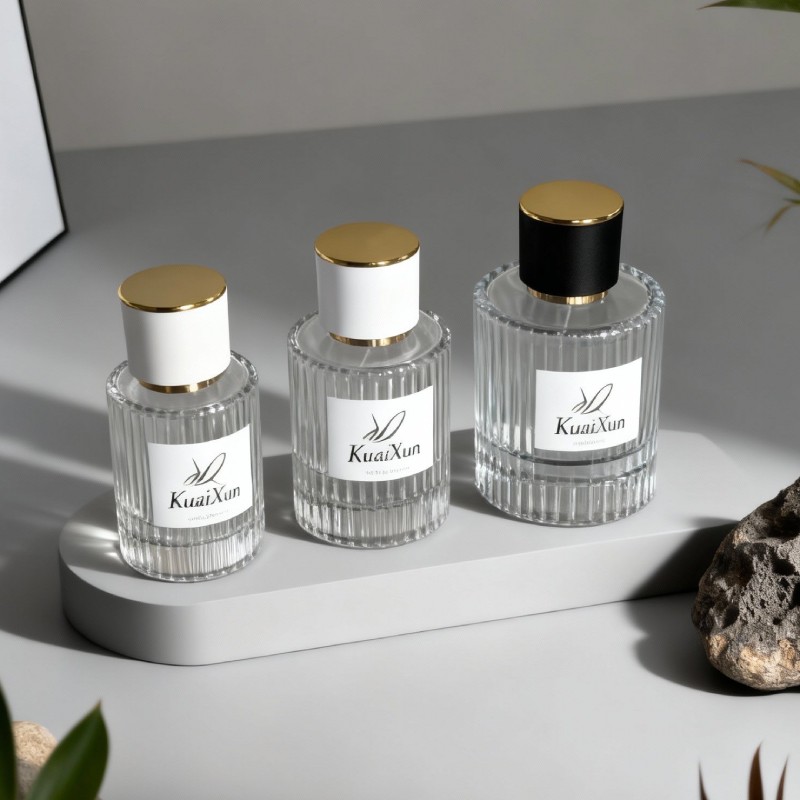
Pressure Decay Validation Under Simulated Cabin Pressure Loss
Pressure decay validation replicates the outward force experienced during air transport by subjecting a sealed bottle to a controlled pressure drop—mirroring high-altitude cargo-hold conditions or rapid cabin decompression. At a typical cruise pressure of 75 kPa, a sea-level-sealed bottle experiences ~26 kPa outward stress across the pump, crimp, and gasket. In practice, the bottle is placed in a pressure chamber, external pressure is reduced from 101 kPa to 75 kPa within 10–15 minutes (to simulate takeoff or emergency descent), and transducers monitor internal or chamber pressure changes. A sustained pressure rise signals gas escape through the closure system. Unlike static vacuum tests, this dynamic outward stress reveals cap-related leaks—such as partial liner lift or thread slippage—that steady-state methods often miss.
High-Sensitivity Verification: Helium Tracer Testing for Critical Closures
When Helium Leak Detection (ASTM F2391) Justifies Cost for Premium Perfume Bottles
Helium tracer testing detects leaks orders of magnitude smaller than vacuum or pressure decay methods—making it the gold standard for validating closure integrity in premium and limited-edition perfume bottles. Per ASTM F2391, helium is introduced around the sealed flacon while a mass spectrometer samples for escaping tracer gas. Because sensitivity is largely independent of headspace volume, it works effectively even for small or partially filled bottles. While its cost and operational complexity preclude inline use, it delivers unmatched defensibility for design validation, closure qualification, and post-simulation audits. For luxury products—where a single leaker risks evaporation, cosmetic damage, and reputational harm—helium leak detection provides the strongest evidence that a bottle remains hermetically sealed through the full spectrum of altitude, vibration, and thermal stress.
Real-World Distribution Simulation: Validating Perfume Bottle Integrity End-to-End
Combined Vibration, Compression, and Environmental Stress Profiling (ASTM D6653/D5094)
A single lab-based leak test rarely predicts real-world performance. In distribution, perfume bottles endure stacked load, road vibration, and temperature swings—not in isolation, but in sequence. Combined profiling begins with filled, sealed bottles in actual secondary packaging. Vibration tables apply industry-standard truck and air-freight frequency profiles; compression plates simulate warehouse stacking loads; and thermal chambers cycle temperatures between 5°C and 40°C to accelerate closure fatigue. Altitude-related pressure changes are introduced using vacuum protocols aligned with ASTM D6653/D5094. Mass loss is measured before and after the full sequence. A robust bottle shows no visible leakage and ≤0.5% fragrance weight loss—validating closure stability under realistic, cumulative transport stress—not idealized lab conditions.
FAQ
Why do perfume bottles tend to leak during transport?
Perfume bottles may leak due to pressure differentials in air transport, sustained vibrations, thermal cycling, or stacking compression during ground distribution. These factors can compromise the integrity of the closure system.
What types of leak tests are commonly used for perfume bottles?
The most commonly used tests are vacuum decay and pressure decay testing. These methods help identify gas movement across closures under controlled conditions.
How does helium testing provide added assurance?
Helium testing detects minor leaks with high sensitivity, making it ideal for premium or limited-edition bottles where even small leaks can cause major issues.
Why is real-world distribution simulation important?
Lab tests alone don’t replicate the combined stresses perfume bottles face during transport, like vibration, compression, and temperature swings. Distribution simulation ensures bottles perform well under realistic conditions.